Jun 1, 20225 min read
Phase Transitions in Potts Models
Research with Prof. A. Nihat Berker on first-order to second-order phase transition changeover and latent heats of q-state Potts models in two and three dimensions.

The project introduced a simple and physically motivated adaptation of the Migdal-Kadanoff renormalization-group method and used it to study the q-state Potts model. The outcome was a single, easily computed change to the standard procedure that captures the order of the Potts transition, recovers the latent heats, and sharpens the predicted transition temperatures in two and three dimensions.
The model
In the q-state Potts model every lattice site carries a spin that can take one of q values, and neighboring spins are rewarded for agreeing. The Hamiltonian is
where , each spin runs over the values , and the delta function is one when two neighbors share the same state and zero otherwise. Above one dimension the transition changes character as q grows. It stays continuous and second order for small q and turns discontinuous and first order once q passes a threshold that depends on the dimension, with that threshold equal to four in two dimensions and two in three. The conventional Migdal-Kadanoff approximation, for all its simplicity and popularity, misses this entirely and predicts a second-order transition for every value of q.
The method
The Migdal-Kadanoff transformation rewrites the interaction between two neighboring spins as a transfer matrix and renormalizes it in two steps. Bond-moving removes some bonds and strengthens the survivors to compensate, and decimation then sums over the intermediate spins to leave a renormalized interaction between the remaining sites. The same recursion is exact on a hierarchical lattice, which is what makes the approximation reliable enough to be so widely used.
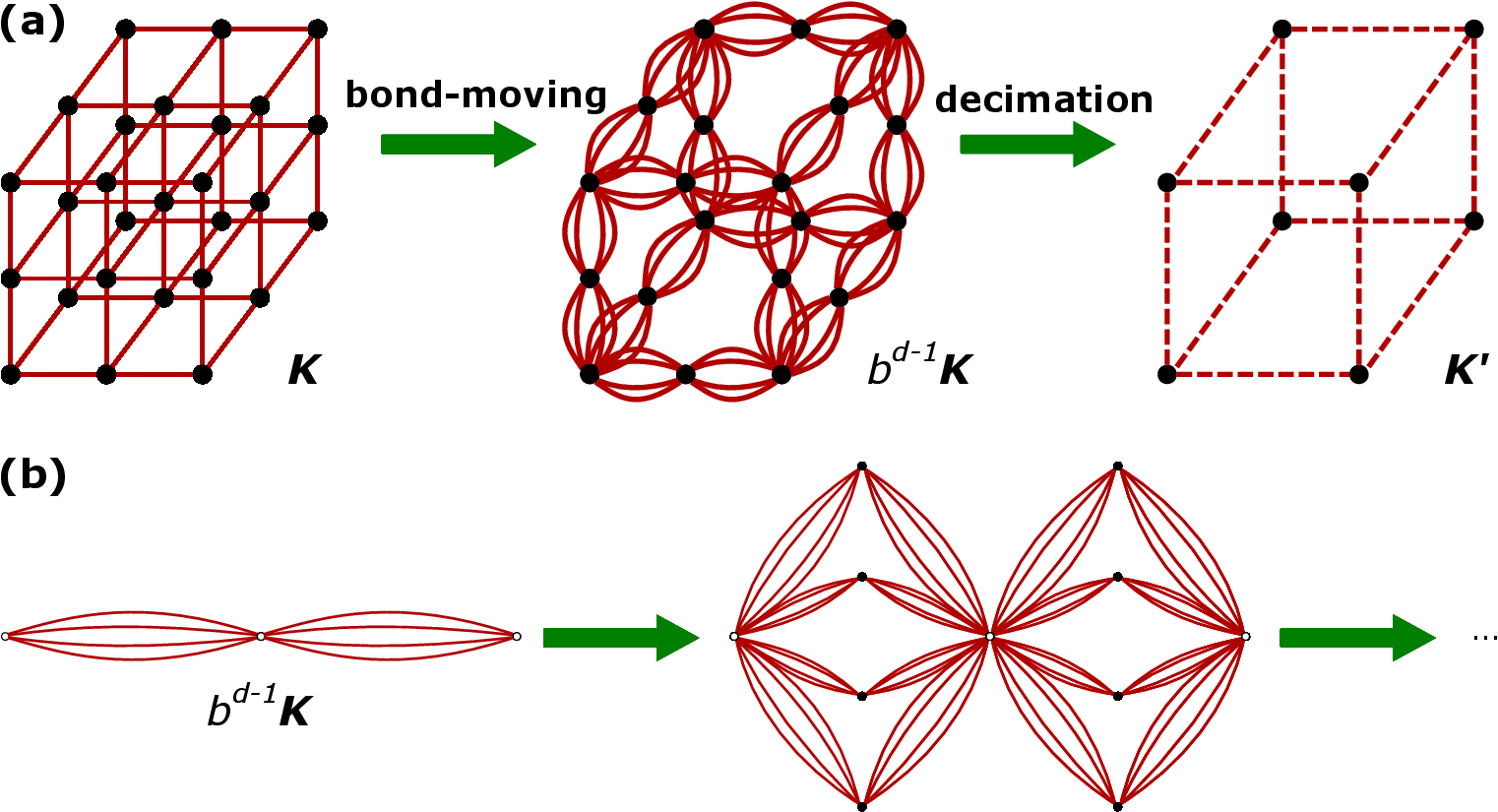
The Migdal-Kadanoff transformation on the three-dimensional cubic lattice. Bond-moving strengthens the remaining bonds and decimation removes the intermediate sites. The same recursion is exact on the hierarchical lattice shown below.
Written out, the conventional transfer matrix carries the Boltzmann weight on its diagonal and unity off it, shown here for the three-state case,
Bond-moving raises each element to the power , where is the length-rescaling factor of the transformation, and decimation multiplies of these matrices together. Following the flow of this matrix under repeated transformation determines the transition and every thermodynamic density of the model.
A simple adaptation
The cure is to add one local disorder state to the transfer matrix. Inside an ordered region a disordered site costs no energy yet carries a multiplicity of , the entropy that favors disorder at large q, and this on-site weight is shared with no approximation across the bonds meeting at the site. The matrix gains a single row and column,
A first-order transition now reveals itself when, under repeated rescaling, this added effective-vacancy entry grows to dominate the matrix rather than the original block of q states staying dominant together.
Thermodynamics and latent heats
The same trajectory yields the full thermodynamics. After each step the transfer matrix is divided by its largest element to keep the numbers from overflowing, which is equivalent to subtracting a constant from the Hamiltonian, and summing those constants along the trajectory gives the dimensionless free energy per bond,
A derivative of the free energy with respect to returns the energy density , and the size of its jump at a first-order transition is the latent heat.
Results
The adapted method recovers the changeover from second-order to first-order behavior at q equal to two in three dimensions exactly and at q equal to four in two dimensions, the latter after a small and physically justified correction described below. It also brings the predicted transition temperatures into close agreement with the exact self-duality result in two dimensions and the Monte Carlo result in three dimensions, a marked improvement over the conventional approximation that joins the exact values for q of about ten and above in two dimensions and about five and above in three.
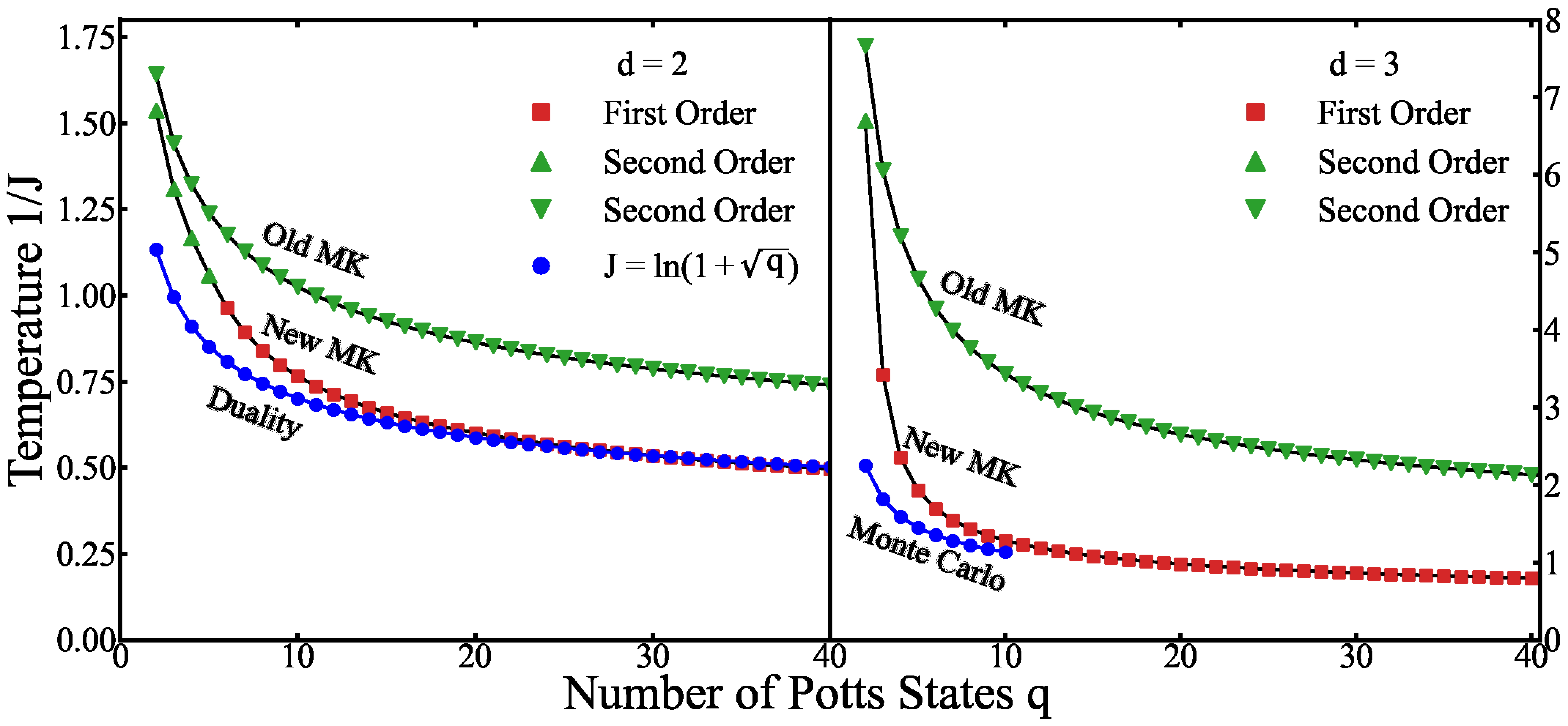
Transition temperatures 1/J of the q-state Potts model in two and three dimensions. The conventional Migdal-Kadanoff result labelled Old MK sits well above the exact values, while the adapted method labelled New MK falls close to the exact self-duality result in two dimensions and the Monte Carlo result in three. Triangles mark second-order transitions and squares mark first-order transitions.
The energy densities make the order of each transition visible. A first-order transition shows a latent-heat jump while a second-order one varies smoothly through the transition.
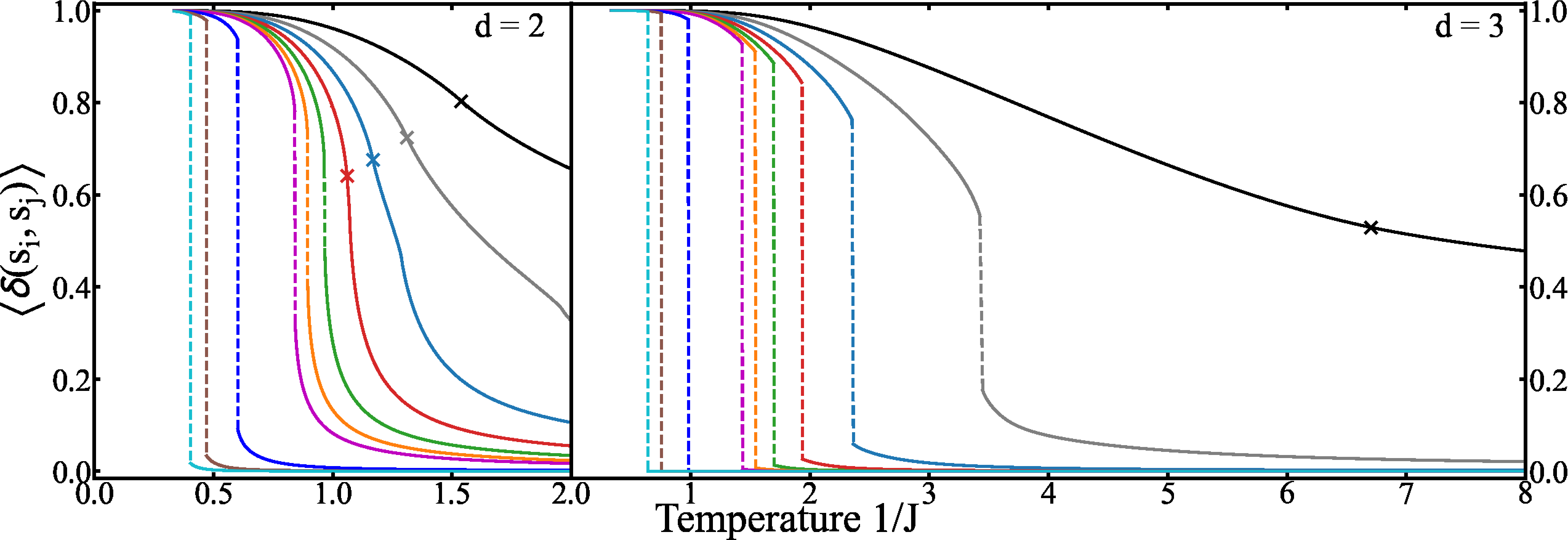
Energy densities of the q-state Potts model in two and three dimensions for q equal to 2, 3, 4, 5, 6, 7, 8, 20, 50, and 100. The dashed vertical jumps are the latent heats of the first-order transitions and the crosses mark the second-order transitions.
In two dimensions the raw calculation lands just shy of the known answer and places the changeover after q equal to five rather than four. The reason is physical. In the middle of a disordered island every state contributes to the local multiplicity, so subtracting slightly overcounts. Replacing the multiplicity with restores the expected first-order jump at q equal to five and brings the changeover down to q equal to four.
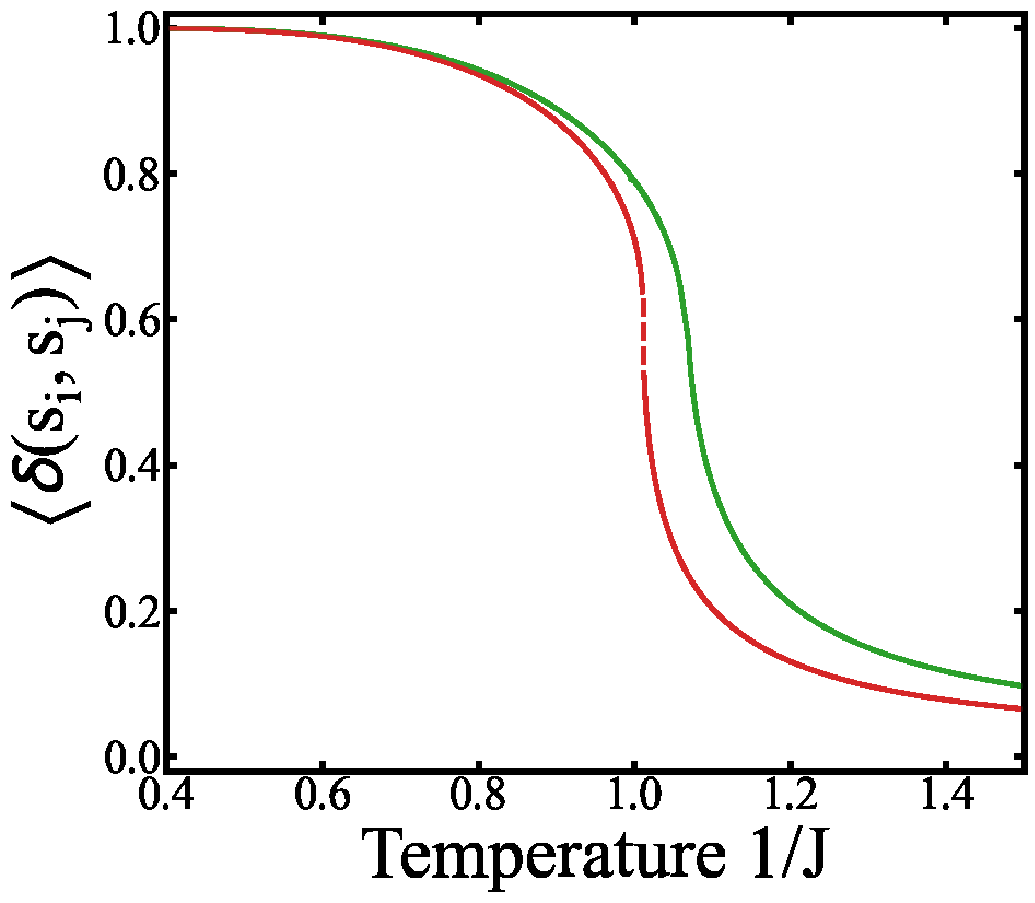
Energy density for q equal to five in two dimensions. With the multiplicity taken as q minus one the green curve stays continuous, while the small physically motivated correction to q minus 0.25 gives the red curve its first-order jump and places the changeover at q equal to four.
The work was published in Physical Review E.